
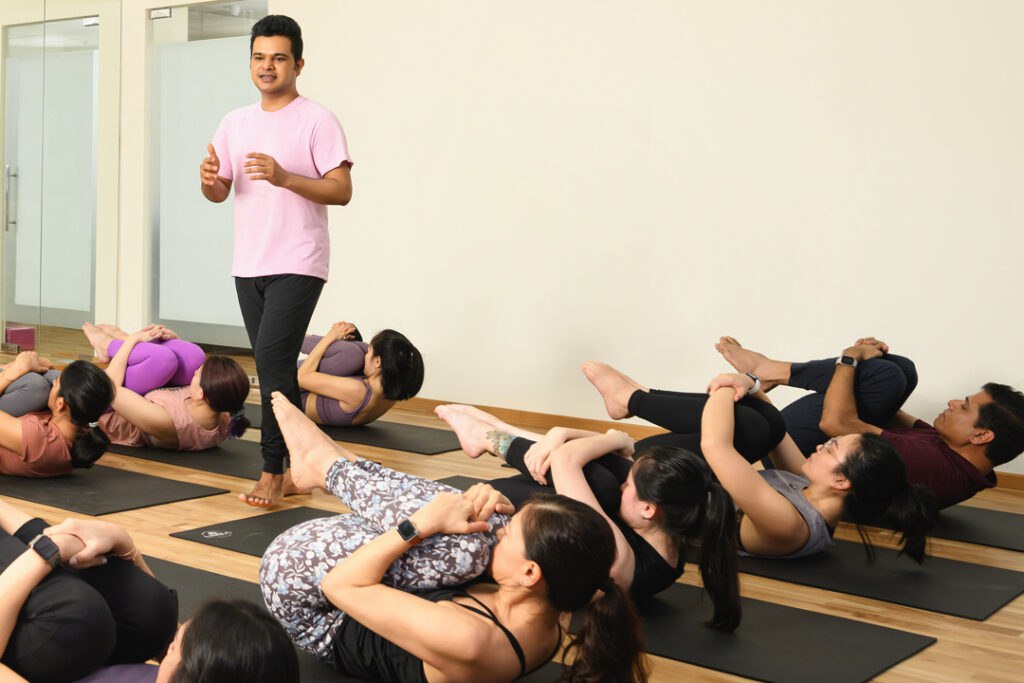
Singapore’s population is ageing at a pace that carries significant public health implications. By 2030, approximately one in four Singaporeans will be aged 65 or older, and the pressures this places on healthcare infrastructure, workplace productivity and individual quality of life are already being felt. Among the many physiological changes that accompany ageing, proprioceptive decline is one of the least discussed but most consequential. It is also one of the most responsive to targeted intervention, and the structured environment of a well-run yoga studio Singapore turns out to be particularly well suited to delivering that intervention in a consistent, accessible format.
What Proprioception Is and Why Its Decline Matters
Proprioception is the body’s internal sense of its own position, movement and spatial orientation. It is generated by mechanoreceptors distributed throughout the muscles, tendons, joint capsules and skin, which continuously send information to the brain about where each body part is in space, how fast it is moving and how much force is being exerted. The brain uses this information to maintain balance, coordinate movement and prevent falls.
Proprioceptive acuity declines measurably with age. The mechanoreceptors themselves become less sensitive, the speed at which sensory signals travel along peripheral nerves slows, and the central processing of proprioceptive information becomes less efficient. The practical consequences of this decline are substantial:
- Reduced balance and an increased risk of falls, which are the leading cause of injury-related hospitalisation in older Singaporeans
- Impaired joint position sense, which increases the likelihood of ankle sprains, knee injuries and other joint incidents during everyday activity
- Slower postural correction responses, meaning the body is less capable of preventing a stumble from becoming a fall
- Reduced movement confidence, which leads to a self-reinforcing cycle of physical inactivity that accelerates further decline
What makes proprioceptive decline particularly insidious is that it is largely invisible until a fall or injury makes it undeniable. Many people in their 40s, 50s and 60s are walking around with significantly impaired proprioception without being aware of it, because they have not yet encountered the circumstances that expose it. Singapore’s predominantly desk-based professional culture compounds this by reducing the variety of physical challenges that the proprioceptive system needs to stay sharp.
Why Studio Yoga Is Effective for Proprioceptive Training
Yoga, practised in a well-structured studio environment, is exceptionally well designed as a proprioceptive training system. This is not a coincidence. The discipline’s historical emphasis on precise body awareness, weight distribution, joint alignment and breath-coordinated movement maps almost exactly onto the requirements for effective proprioceptive conditioning.
Several specific features of studio yoga make it effective for this purpose.
Single-leg balance postures are the most direct proprioceptive training tool in a yoga class. Postures like Tree, Warrior III, Standing Hand to Big Toe and Half Moon require the body to balance on one leg while maintaining a specific shape in the trunk and the lifted limb. This places significant and sustained demand on the ankle, knee and hip mechanoreceptors of the standing leg, as well as the vestibular system and the visual system. Regular practice of these postures has been shown to improve static and dynamic balance measures, reduce sway velocity on force plates, and improve scores on clinical balance assessments used in fall prevention research.
Eyes-closed variations add a layer of difficulty that specifically targets the proprioceptive system rather than the visual system. When visual input is removed, the body must rely entirely on mechanoreceptor feedback to maintain balance. Studio teachers who periodically cue eyes-closed variations of standing balance postures are providing one of the most direct proprioceptive training stimuli available in a group class setting.
Varied surfaces and prop challenges further enrich proprioceptive input. Practising balance on a folded blanket, a block or a slightly unstable surface creates unpredictable mechanical feedback that challenges the proprioceptive system more intensely than a stable floor. Well-equipped studios that incorporate these challenges selectively and safely accelerate proprioceptive adaptation in their students.
Slow, controlled transitions between postures are proprioceptively demanding in ways that quick, momentum-driven movement is not. When a teacher cues students to move from Warrior I to Warrior II in a slow, deliberate count of eight, the muscles responsible for controlling the transition must maintain continuous proprioceptive feedback to coordinate the movement without overshooting or losing stability. This kind of slow movement training is particularly beneficial for older practitioners, whose proprioceptive processing speed is most in need of targeted stimulus.
The Singapore-Specific Context: Sedentary Work Patterns
Singapore’s workforce spends an extraordinary proportion of its waking hours seated. Prolonged sitting reduces the mechanical loading on the proprioceptors in the lower limbs, ankles and feet, which are critical for balance control. Like any sensory system, the proprioceptive system degrades with disuse and responds positively to challenge and variety. A population that spends eight to ten hours daily in a chair is systematically depriving its proprioceptive system of the input it needs to remain functional.
This is why the proprioceptive benefits of yoga are arguably more important for Singapore’s working population than for populations with more physically varied daily lives. A farmer, a construction worker or a physiotherapist maintains their proprioceptive system through the demands of their work. A software engineer, lawyer or financial analyst does not. For these professionals, the proprioceptive training in a well-designed yoga class may be the only meaningful challenge their balance system receives in a given week.
What to Look for in Studio Programming for Proprioceptive Benefit
Not all yoga classes provide equivalent proprioceptive training. The format, sequencing and teacher priorities of a class determine how much proprioceptive challenge is delivered. Practitioners interested in maximising the fall-prevention and balance benefits of their studio attendance should look for the following:
- Classes that include a dedicated standing balance sequence, rather than treating balance postures as transitional movements
- Teachers who provide options for increasing challenge, such as eyes-closed variations or unstable surface work, for those who are ready
- Sequencing that includes slow, controlled transitions rather than relying on momentum
- Programmes that progress over time rather than cycling through the same sequence indefinitely, as proprioceptive adaptation requires progressive challenge to continue
Studios offering classes specifically designed for older practitioners, or that provide clear progression pathways within their general programming, are the most valuable resources for proprioceptive training in Singapore’s ageing workforce. The investment in consistent studio attendance for this purpose is not a wellness indulgence. For older practitioners, it is a clinically meaningful fall prevention strategy that significantly reduces one of the most serious health risks associated with ageing.
Yoga Edition is among the Singapore studios that takes the diversity of its student population seriously in its class design, recognising that effective yoga programming for middle-aged and older practitioners requires a different emphasis than classes designed for younger, more physically robust students.
